Monday, October 24, 2011

Spiny Dogfish Pictures

##title##
Sharks (superorder Selachimorpha) are a type of fish with a full cartilaginous skeleton and a highly streamlined body. The earliest known sharks date from more than 420 million years ago.
Well-known species such as the great white shark, tiger shark, blue shark, mako shark, and the hammerhead are apex predators, at the top of the underwater food chain. Their extraordinary skills as predators fascinate and frighten humans, even as their survival is under serious threat from fishing and other human activities.
Until the 16th century, sharks were known to mariners as "sea dogs". The etymology of the word "shark" is uncertain. One theory is that it derives from the Yucatec Maya word xok, pronounced 'shok'. Evidence for this etymology comes from the OED, which notes the name "shark" first came into use after Sir John Hawkins' sailors exhibited one in London in 1569 and used the word "sharke" to refer to the large sharks of the Caribbean Sea.
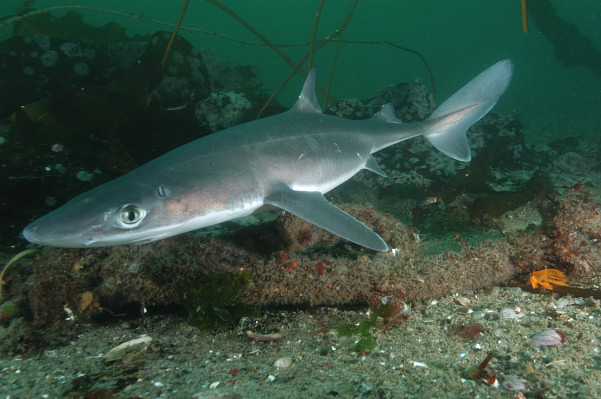
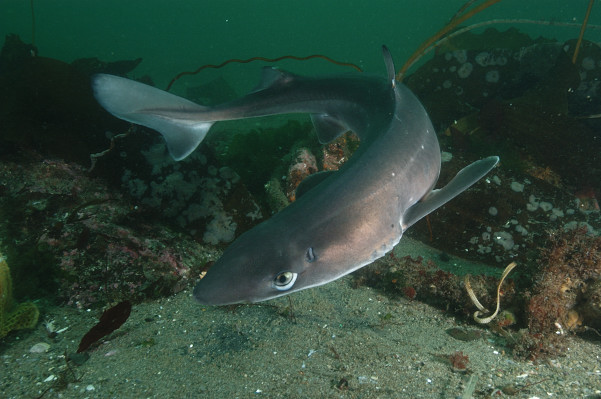
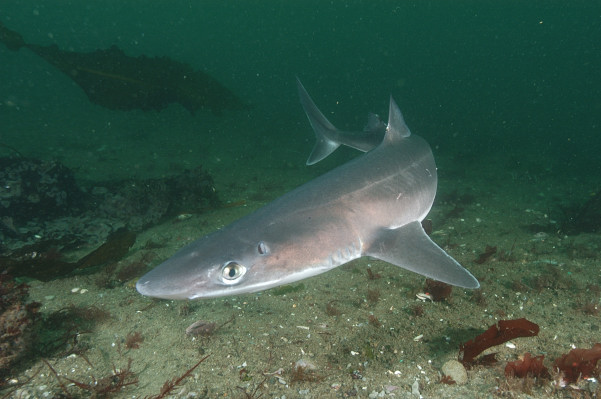
Spiny dogfish #059


Spiny dogfish #070


Spiny Dogfish Shark


spiny dogfish


Spiny dogfish embryo

An alternate etymology states that the original sense of the word was that of "predator, one who preys on others" from the German Schorck, a variant of Schurke "villain, scoundrel" (cf. card shark, loan shark, etc.), which was later applied to the fish due to its predatory behaviour.

Spiny Dogfish Shark Pictures


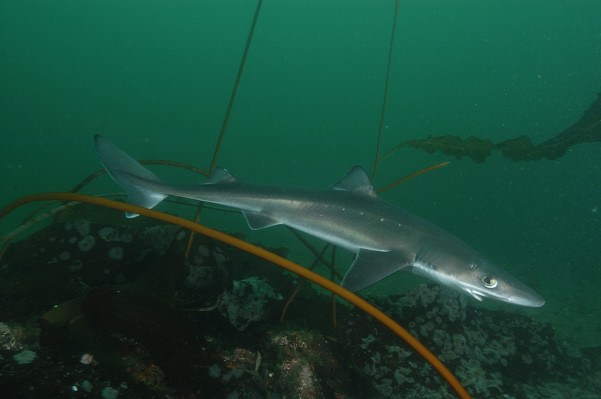
Spiny Dogfish


The spiny dogfish, also known


Spiny dogfish


Spiny dogfish swimming amongst

Shark teeth are embedded in the gums rather than directly affixed to the jaw, and are constantly replaced throughout life. Multiple rows of replacement teeth grow in a groove on the inside of the jaw and steadily move forward as in a "conveyor belt"; some sharks lose 30,000 or more teeth in their lifetime. The rate of tooth replacement varies from once every 8–10 days to several months. In most species teeth are replaced one at a time, except in cookiecutter sharks the entire row of teeth is replaced simultaneously.
Tooth shape depends on diet: sharks that feed on mollusks and crustaceans have dense flattened teeth for crushing, those that feed on fish have needle-like teeth for gripping, and those that feed on larger prey such as mammals have pointed lower teeth for gripping and triangular upper teeth with serrated edges for cutting. The teeth of plankton-feeders such as the basking shark are smaller and non-functional.

for female spiny dogfish


Common Names: Spiny dogfish,


Spiny Dogfish


the Spiny Dogfish (Squalus


Facts: Spiny Dogfish Shark

Shark skeletons are very different from those of bony fish and terrestrial vertebrates. Sharks and other cartilaginous fish (skates and rays) have skeletons made of cartilage and connective tissue. Cartilage is flexible and durable, yet has about half the density of bone. This reduces the skeleton's weight, saving energy. Sharks have no rib cage and therefore on land a shark's own weight can crush it. Like its relatives, rays and skates, the shark's jaw is not attached to the cranium. The jaw's surface, like the shark's vertebrae and gill arches, needs extra support due to its heavy exposure to physical stress and its need for strength. It has a layer of tiny hexagonal plates called "tesserae", which are crystal blocks of calcium salts arranged as a mosaic. This gives these areas much of the same strength found in the bony tissue found in other animals. Generally sharks have only one layer of tesserae, but the jaws of large specimens, such as the bull shark, tiger shark, and the great white shark, have two to three layers or more, depending on body size. The jaws of a large great white shark may have up to five layers. In the rostrum (snout), the cartilage can be spongy and flexible to absorb the power of impacts.

spiny dogfish embryo (19 cm TL


Spiny dogfish, notice the


spiny-dogfish-shark


Spiny Dogfish - Squalus


Spiny Dogfish

Love Poems

##title##
Poetry (from the Greek 'poiesis'/ποίησις [poieo/ποιέω], a making: a forming, creating, or the art of poetry, or a poem) is a form of literary art in which language is used for its aesthetic and evocative qualities in addition to, or in lieu of, its apparent meaning. Poetry may be written independently, as discrete poems, or may occur in conjunction with other arts, as in poetic drama, hymns, lyrics, or prose poetry. It is published in dedicated magazines (the longest established being Poetry and Oxford Poetry), individual collections and wider anthologies.
Poetry primarily is governed by idiosyncratic forms and conventions to suggest differential interpretation to words, or to evoke emotive responses. Devices such as assonance, alliteration, onomatopoeia, and rhythm are sometimes used to achieve musical or incantatory effects. The use of ambiguity, symbolism, irony, and other stylistic elements of poetic diction often leaves a poem open to multiple interpretations. Similarly, metaphor, simile, and metonymy create a resonance between otherwise disparate images—a layering of meanings, forming connections previously not perceived. Kindred forms of resonance may exist, between individual verses, in their patterns of rhyme or rhythm.
Some poetry types are specific to particular cultures and genres, responding to the characteristics of the language in which the poet writes. Readers accustomed to identifying poetry with Dante, Goethe, Mickiewicz and Rumi may think of it as being written in lines based upon rhyme and regular meter, there are traditions, such as Biblical poetry, that use other methodologies to create rhythm and euphony. Much of modern British and American poetry is to some extent a critique of poetic tradition, playing with and testing (among other things) the principle of euphony itself, to the extent that sometimes it deliberately does not rhyme or keep to set rhythms at all. In today's globalized world poets often borrow styles, techniques and forms from diverse cultures and languages.

Personalized Love Poems From


Love Poems


sent love sms, love poems


Love Poems 12 - Love Quotes,


poems love 3 550x350

Poetry as an art form may predate literacy. Epic poetry, from the Indian Vedas (1700–1200 BC) and Zoroaster's Gathas (1200-900 BC) to the Odyssey (800–675 BC), appears to have been composed in poetic form to aid memorization and oral transmission, in prehistoric and ancient societies. Other forms of poetry developed directly from the recording of folk songs. The earliest entries in the Han Dynasty Shijing (1000 BC) were initially lyrics, preceding later entries intended to be read. Poetry appears among the earliest records of most literate cultures, with poetic fragments found on early monoliths, runestones, and stelae.

Love Poems Album


sad love poem


Free Poems eCards, Greeting


Love Poems


Love Poem (1)

The oldest surviving epic poem is the Epic of Gilgamesh, from the 3rd millennium BC in Sumer (in Mesopotamia, now Iraq), which was written in cuneiform script on clay tablets and, later, papyrus. Other ancient epic poetry includes the Greek epics Iliad and Odyssey, the Old Iranian books the Gathic Avesta and Yasna, the Roman national epic, Virgil's Aeneid, and the Indian epics Ramayana and Mahabharata.
The efforts of ancient thinkers to determine what makes poetry distinctive as a form , and what distinguishes good poetry from bad, resulted in "poetics"—the study of the aesthetics of poetry. Some ancient societies, such as the Chinese through the Shi Jing, one of the Five Classics of Confucianism, developed canons of poetic works that had ritual as well as aesthetic importance. More recently, thinkers have struggled to find a definition that could encompass formal differences as great as those between Chaucer's Canterbury Tales and Matsuo Bashō's Oku no Hosomichi, as well as differences in context spanning Tanakh religious poetry, love poetry, and rap.

To My Dear and Loving Husband


love poems #1


Love Poems


I write love poems for her


Love poems are a wonderfully

Context can be critical to poetics and to the development of poetic genres and forms. Poetry that records historic events in epics, such as Gilgamesh or Ferdowsi's Shahnameh, will necessarily be lengthy and narrative, while poetry used for liturgical purposes (hymns, psalms, suras, and hadiths) is likely to have an inspirational tone, whereas elegy and tragedy are meant to evoke deep emotional responses. Other contexts include Gregorian chants, formal or diplomatic speech, political rhetoric and invective, light-hearted nursery and nonsense rhymes, and even medical texts. The Polish historian of aesthetics, Władysław Tatarkiewicz, in a paper on "The Concept of Poetry," traces the evolution of what is in fact two concepts of poetry. Tatarkiewicz points out that the term is applied to two distinct things that, as the poet Paul Valéry observed, "at a certain point find union. Poetry [...] is an art based on language. But poetry also has a more general meaning [...] that is difficult to define because it is less determinate: poetry expresses a certain state of mind." Classical thinkers employed classification as a way to define and assess the quality of poetry. Notably, the existing fragments of Aristotle's Poetics describe three genres of poetry—the epic, the comic, and the tragic—and develop rules to distinguish the highest-quality poetry in each genre, based on the underlying purposes of the genre. Later aestheticians identified three major genres: epic poetry, lyric poetry, and dramatic poetry, treating comedy and tragedy as subgenres of dramatic poetry.

Love Poems Album


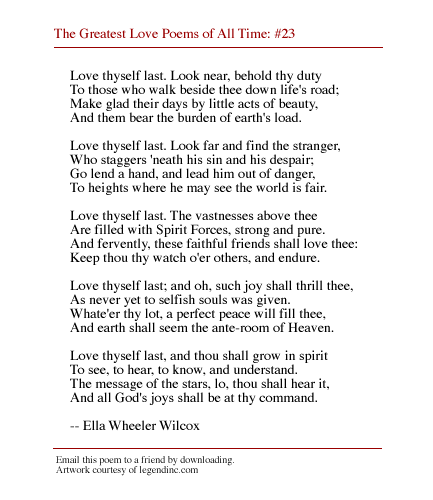
\x26quot;Love Thyself Last.\x26quot;


Classic Love Poems Page 5


send sms about love poems


Monday, May 23, 2011

Quotes About Family In Spanish

##title##
Louis began his personal rule of France in 1661 after the death of his chief minister, the Italian Cardinal Mazarin. An adherent of the theory of the divine right of kings, which advocates the divine origin and lack of temporal restraint of monarchical rule, Louis continued his predecessors' work of creating a centralized state governed from the capital. He sought to eliminate the remnants of feudalism persisting in parts of France and, by compelling the noble elite to inhabit his lavish Palace of Versailles, succeeded in pacifying the aristocracy, many members of which had participated in the Fronde rebellion during Louis' minority. By these means he consolidated a system of absolute monarchical rule in France that endured until the French Revolution.
Upon his death just days before his seventy-seventh birthday, Louis was succeeded by his five-year-old great-grandson, Louis XV. All his intermediate heirs—his son Louis, le Grand Dauphin; the Dauphin's eldest son Louis, duc de Bourgogne; and Bourgogne's eldest son and his second eldest son, Louis, duc de Bretagne (the older brothers of the future Louis XV)—predeceased him.
Louis XIV was born on 5 September 1638 in the Chateau of Saint-Germain-en-Laye to Louis XIII and Anne of Austria. At the time of his birth, his parents had been married for twenty-three years without surviving issue (his mother experienced four stillbirths between 1619 and 1631). Leading contemporaries thus regarded him as a divine gift, and his birth, a miracle of God. He was often referred to as "Louis-Dieudonné" (Louis-God-given) and also bore the traditional title of French heirs apparent—Dauphin.

Spanish Proverb family reunion


Students Quotes - CICU Spanish


Family quotes


quotes back to Portuguese good, except when Family+quotes+in+spanish


Classic quotes worth more spanish love Blood is , wall Spanish and

Recognising that his death was imminent, Louis XIII in 1643 prepared for his son's impending minority rule. He decreed that a regency council should rule on Louis's behalf for the duration of the minority. Contrary to custom, he did not make Anne the sole regent despite her having given birth to Louis and his brother Philippe, because he doubted her political abilities. He did however make her the head of the Council.

…and 501 Spanish Verbs…


quotes free website translation quotes Family+quotes+in+spanish


My Spanish Family


keep families intact


Spanish Quotes About Life

On 14 May 1643, with Louis XIII dead, Anne had her husband's will annulled by the Parlement de Paris (a judicial body comprising mostly nobles and high clergymen), abolished the regency council, and became the sole regent. She then entrusted power to Cardinal Mazarin.
Subsequently, in 1648, Mazarin successfully negotiated the Peace of Westphalia. Although war continued between France and Spain until the Treaty of the Pyrenees in 1659, the Peace of Westphalia ended the Thirty Years' War in Germany. Its terms ensured Dutch independence from Spain, awarded some autonomy to the various German princes, and granted Sweden seats on the Imperial Diet and territories to control the mouths of the Oder, Elbe and Weser. France, however, profited most from the settlement. Austria ceded to France all Habsburg lands and claims in Alsace and acknowledged her de facto sovereignty over the Three Bishoprics. Moreover, eager to emancipate themselves from Habsburg domination, petty German states sought French protection. This anticipated the formation of the 1658 League of the Rhine, leading to the further diminution of Imperial power.

Spanish, MN Twins, quotes,


sympathy quotes Spanish


quotes, friends, family,


Filipino Spanish. Friends.


in a family of Spanish,

As the Thirty Years' War came to an end, a civil war—the Fronde—erupted in France. It effectively checked France's ability to exploit the Peace of Westphalia. Mazarin had largely pursued the policies of his predecessor, Cardinal Richelieu, augmenting the Crown's power at the expense of the nobility and the Parlements. The Frondeurs, political heirs of a dissatisfied feudal aristocracy, sought to protect their traditional feudal privileges from an increasingly centralized royal government. Furthermore, they believed their traditional influence and authority was being usurped by the recently ennobled bureaucrats (the Noblesse de Robe) who administered the Kingdom and on whom the Monarchy increasingly began to rely. This belief intensified their resentment. In 1648, Mazarin attempted to tax members of the Parlement de Paris. The members not only refused to comply, but also ordered all his earlier financial edicts burned. Buoyed by the victory of Louis, duc d'Enghien (later le Grand Condé) at Lens, Mazarin arrested certain members in a show of force. Paris erupted in rioting. A mob of angry Parisians broke into the royal palace and demanded to see their king. Led into the royal bedchamber, they gazed upon Louis, who was feigning sleep, were appeased, and quietly departed. The threat to the royal family prompted Anne to flee Paris with the king and his courtiers. Shortly thereafter, the conclusion of the Peace of Westphalia allowed Condé's army to return to aid Louis and his court. As this first Fronde (Fronde parlementaire, 1648–1649) ended, a second (Fronde des princes, 1650–1653) began. Unlike that which preceded it, tales of sordid intrigue and half-hearted warfare characterised this second phase of upper-class insurrection. To the aristocracy, this rebellion represented a protest against and a reversal of their political demotion from vassals to courtiers. It was headed by the highest-ranking French nobles, among them Louis's uncle, Gaston, duc d'Orléans, and first cousin, la Grande Mademoiselle; more distantly related Princes of the Blood, like Condé, his brother, Conti, and their sister the duchesse de Longueville; dukes of legitimised royal descent, such as Henri, duc de Longueville, and François, duc de Beaufort; and princes étrangers, such as Frédéric Maurice, duc de Bouillon, his brother, the famous Marshal of France, Turenne, and Marie de Rohan, duchesse de Chevreuse; and scions of France's oldest families, such as François, duc de La Rochefoucauld.

family quotes, quotes of


family quotes, quotes of


Carter IV (Deluxe Edition)


Lil Wayne-\x26#39;Tha Carter IV


Carter IV Deluxe EDITION!